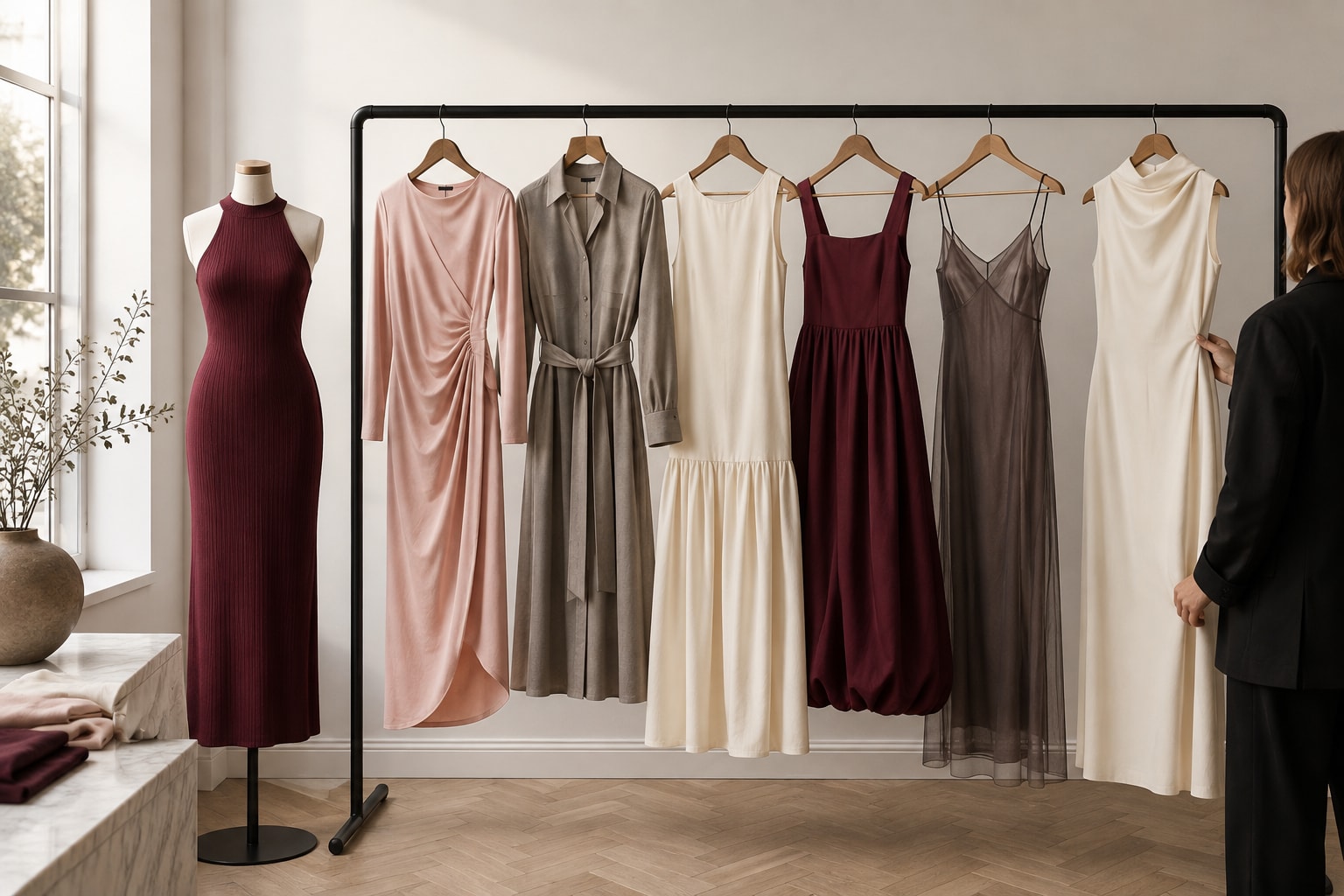
A careful reading of seven dress directions highlighted in recent fashion coverage, with practical shopping questions and clear limits on what the available evidence establishes.
What the Recent 2026 Dress-Trend Coverage Actually Says
A Harper’s BAZAAR overview published on July 10, 2026 identifies seven summer-dress directions: bodycon, column, poplin, sheer, fringe, babydoll, and eyelet. This is a useful snapshot of how one professional fashion publication is organizing the season’s dress conversation.
The evidence should not be stretched beyond that. The supplied research does not demonstrate search growth, sales momentum, social-media virality, a popularity ranking, or agreement across the fashion industry. It also does not establish that prairie dresses have disappeared from stores or wardrobes. The headline is best understood as the framing of recent fashion coverage, not a measurable declaration that one category has replaced another everywhere.
For shoppers, the seven directions can function as a browsing map rather than a mandatory checklist. They point toward different silhouettes, materials, and surface treatments that can be compared against personal needs.
Bodycon and Column Dresses: Two Different Takes on a Close, Clean Silhouette
Harper’s BAZAAR lists bodycon and column dresses as separate directions in its 2026 overview. The supplied evidence does not provide enough detail to make universal claims about how every retailer defines those terms, so the labels should be treated as starting points rather than standardized specifications.
When comparing garments filed under these categories, inspect the actual product images and measurements instead of relying on the trend name alone. Useful questions include whether the garment follows the body closely throughout, whether its overall line appears straighter, and where its seams or shaping are placed. Check the size chart and stated fabric composition for each product as well; neither can be inferred from a category label.
The practical distinction is therefore made at the individual-garment level. Two dresses placed under different trend labels may still overlap visually, while two products sharing one label may have noticeably different cuts. A shopper choosing between these directions should prioritize the specific silhouette shown and the intended wearing occasion, then verify the seller’s material and sizing information before buying.
Poplin, Sheer, Fringe, and Eyelet: The Fabric and Surface Directions to Know
Four of the seven directions highlighted by Harper’s BAZAAR—poplin, sheer, fringe, and eyelet—organize the trend discussion around fabric or visible surface treatment. The available research confirms their inclusion in the article but does not supply product-level specifications or establish that every dress using one of these labels is constructed in the same way.
A disciplined shopping approach is to use each term as a prompt for closer inspection:
- For a dress described as poplin, verify the listed fiber content and care instructions rather than assuming composition from the category name.
- For a sheer dress, examine product images and the description for information about coverage, lining, and layering. The supplied sources do not establish those details for any specific garment.
- For fringe, check where the decoration appears and consult the care information provided by the seller.
- For eyelet, inspect close-up images, garment construction, and any lining details disclosed on the product page.
These checks do not amount to a claim that one direction is more practical, comfortable, or durable than another. No supporting wear tests or product records were supplied. They simply translate the four reported trend labels into details a shopper can verify. Occasion, preferred coverage, care requirements, and tolerance for decorative elements can then guide the final choice.
Why Babydoll Dresses Are Back in the 2026 Conversation
In its trend analysis, Harper’s BAZAAR connects the 2026 return of babydoll dresses with Olivia Rodrigo and also points to runway signals from Celine and Chloé. That combination places the style within both a public-celebrity reference and the publication’s reading of designer collections.
The attribution matters: this is Harper’s BAZAAR’s editorial interpretation of the trend, based on the signals it selected. The supplied research does not independently prove that babydoll dresses are rising in searches, outselling other silhouettes, or becoming universally dominant. Nor does it establish that any celebrity association applies to every product marketed with the babydoll label.
For shoppers interested in the direction, the useful next step is not to reproduce a celebrity look exactly. Instead, review the cut of each garment, compare it with personal silhouette preferences, and check the retailer’s size and material information. The reported celebrity and runway connections explain why the category appears in the 2026 conversation; they do not replace product-level evaluation.
A Practical Accessories Lens: Considering Boston Clogs Alongside These Dresses
Considering Boston clogs alongside the seven dress directions is an editorial styling exercise, not a source-supported trend connection. The supplied materials do not show that Harper’s BAZAAR linked the Boston collection to its dress report or that the footwear is a defining accessory for these styles.
What the official BIRKENSTOCK US collection page does establish is that numerous Boston variants are listed in materials including suede leather, nubuck leather, oiled leather, and EVA, with multiple colors represented. That range provides several concrete comparison fields—material and color—without proving which option works best with a particular dress.
If exploring this pairing, begin with the dress direction and the intended setting, then compare the listed Boston variants visually. Check the exact product page for the selected variant rather than transferring information from one model to another. Material, size availability, color, price, and stock should all be confirmed at the time of purchase.
This section is not a product ranking or an assertion based on personal wear testing. It offers a way to think about accessories while keeping the documented facts separate from optional styling judgment.
How to Choose a Direction Without Treating a Trend List as a Rule
The seven directions reported by Harper’s BAZAAR can be reduced to a practical screening process. Start with silhouette by comparing the bodycon, column, and babydoll categories. Then consider the material or surface-focused labels: poplin, sheer, fringe, and eyelet. This structure reflects the categories in the coverage; it does not rank them.
Before purchasing, use a product-level checklist:
- Decide which wearing occasions the dress needs to cover.
- Inspect the actual cut instead of relying only on the category name.
- Read the stated material composition and care instructions.
- Look for disclosed details about coverage, lining, and decoration when relevant.
- Consult the seller’s measurements and size guidance.
- Verify the current price, available sizes, colors, and inventory directly with the retailer.
A trend list can narrow a large field of options, but it cannot determine whether a specific garment meets an individual shopper’s requirements. The strongest choice is the direction that survives these practical checks, regardless of how prominently its label appears in seasonal coverage.
Evidence Limits and What Shoppers Should Verify
The evidence base for this guide is narrow: one Harper’s BAZAAR article dated July 10, 2026 and an official BIRKENSTOCK US Boston collection page for which the supplied research provides no publication date. No product records, substantiated user feedback, prices, inventory snapshots, sales data, search data, or independent confirmation of the reported dress trends were supplied.
Accordingly, the article describes what the fashion coverage highlighted; it does not present an industry-wide consensus or popularity ranking. Before buying, shoppers should independently verify each item’s material, construction details, sizing, price, and availability on the relevant retailer page. Any proposed dress-and-clog combination remains editorial styling guidance rather than a documented market development.
Frequently asked questions
What seven dress directions did the recent coverage identify for 2026?
Harper’s BAZAAR identified bodycon, column, poplin, sheer, fringe, babydoll, and eyelet dresses in its July 10, 2026 overview.
Does the available evidence prove these are the most popular dresses of 2026?
No. The supplied evidence does not establish search growth, sales, virality, popularity rankings, or an industry-wide consensus. It supports only that Harper’s BAZAAR highlighted these seven directions.
Why is Olivia Rodrigo mentioned in relation to babydoll dresses?
Harper’s BAZAAR connected the reported 2026 return of babydoll dresses with Olivia Rodrigo and also cited runway signals from Celine and Chloé. This should be attributed to that publication’s trend analysis rather than treated as independent proof of broad adoption.
Are Boston clogs documented as part of these dress trends?
No documented connection is established by the supplied sources. The official BIRKENSTOCK US page only supports that its Boston collection includes numerous variants in materials such as suede leather, nubuck leather, oiled leather, and EVA, across multiple colors. Pairing them with the reported dress directions is an editorial styling idea.
What should shoppers verify before buying one of these styles?
Check the individual product’s cut, material composition, care instructions, measurements, sizing guidance, price, and current availability. For relevant designs, also look for disclosed information about lining, coverage, and decorative construction. The supplied research contains no product records or inventory data.
Disclosures and limitations
- This article was prepared with AI assistance and is based only on the supplied research package: a Harper’s BAZAAR article dated July 10, 2026 and the official BIRKENSTOCK US Boston collection page.
- No products were purchased, worn, tested, or ranked for this article, and no user reviews or personal experiences were used.
- The supplied materials do not disclose an affiliate relationship. Readers should nevertheless be told clearly if commerce links are later added, because the publisher could receive compensation from resulting purchases.
- Product materials, sizing, prices, colors, and inventory can vary by listing and time; verify them directly with the retailer before purchasing.
Sources
- GitHub – mhxion/awesome-discord-communities: A curated list of awesome Discord communities for programmers — GitHub
- Boston Collection | BIRKENSTOCK United States — birkenstock.com
- Answear – online fashion shop App – App Store — App Store
- Goodbye, Prairie Dresses—These Are the Dress Trends of 2026 — Harper's BAZAAR
- Dressrious: Wardrobe & Stylist App – App Store — App Store