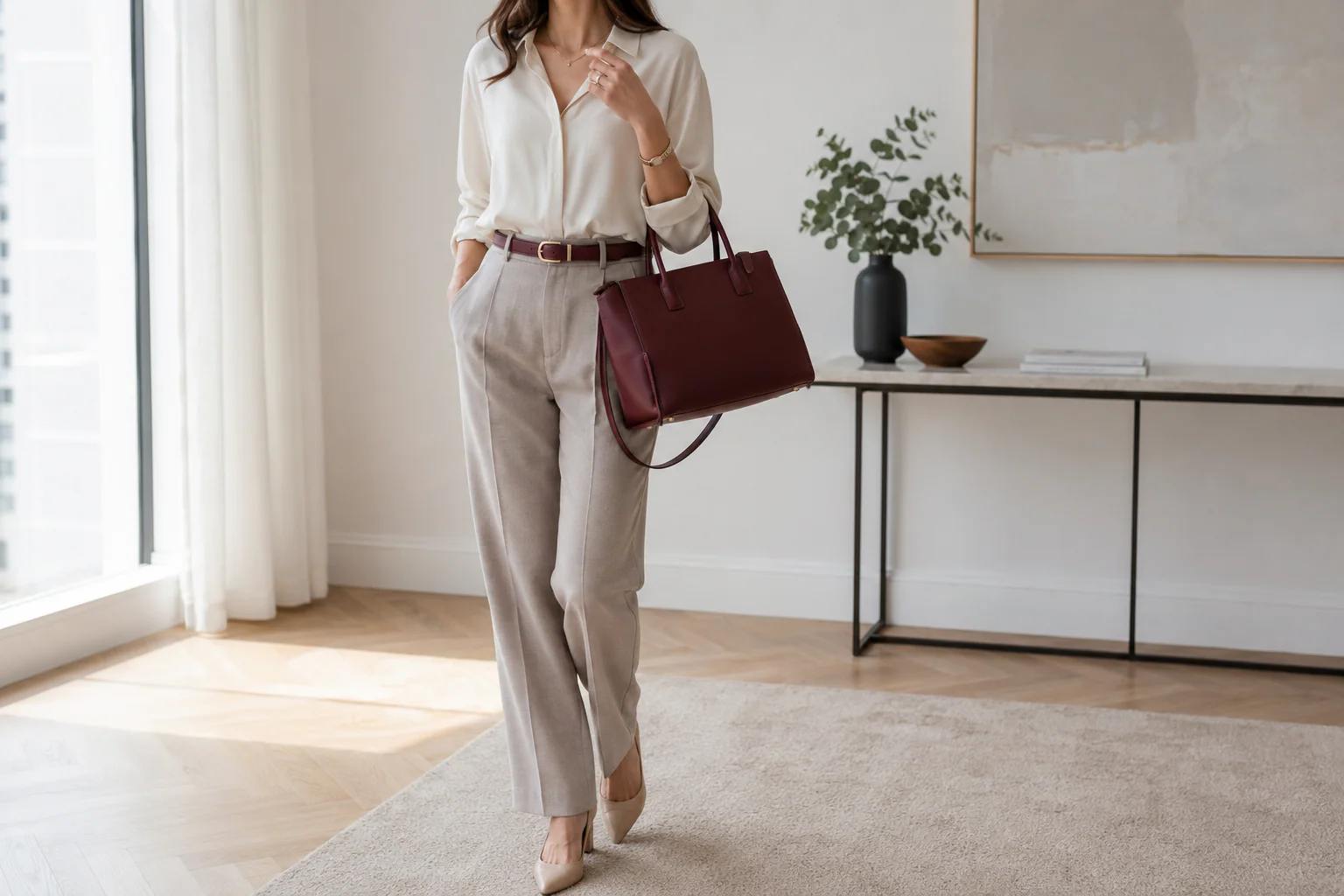
A practical framework for choosing bags, belts, and jewelry by setting, styling purpose, and verifiable specifications—while separating editorial guidance from retailer claims.
Why Everyday Accessories Should Start With the Outfit’s Purpose
Begin with two questions: Where will you wear the outfit, and what should the accessory contribute? The supplied retailer guidance groups everyday dressing around professional, social, and leisure settings and presents bags, belts, necklaces, and bracelets as outfit-finishing elements. These are retailer-defined roles, not independent styling rules.
For a practical decision, assign each accessory one main job. A bag can address what you need to carry while contributing to the overall look. A belt can alter the visual structure of an outfit, but it must also work in terms of size and construction. Jewelry can provide a visual focal point or help move an outfit toward a more occasion-ready appearance. These are editorial applications of the supplied retailer guidance rather than tested conclusions.
You do not necessarily need a completely different accessory set for every setting. Instead, identify the day’s dominant context and decide whether function, silhouette, or visual emphasis should take priority.
How to Choose an Everyday Bag Across Different Settings
The captured Anne Fontaine page listed 30 bags across crossbody, mini, handbag, boho, and tote styles. That variety supports comparing bag types, but it does not establish that any one style is objectively best for a particular occasion.
Start with your carrying requirements. List what the bag must accommodate, then eliminate shapes that cannot plausibly meet that need. Next, consider the main setting: professional, social, or leisure. Anne Fontaine positions its everyday bags as combining practicality and style across these contexts, but that is the retailer’s promotional framing rather than an independently verified performance assessment.
Use the available shapes as a comparison shortlist. A tote, handbag, crossbody, mini bag, or boho style should be evaluated against the same questions: Does the format match what you need to carry? Does it make sense for the dominant setting? Does its visual role support rather than distract from the outfit’s purpose? These questions are an editorial selection method, not claims about the capacity or performance of the listed products.
Do not infer durability, comfort, organization, or versatility from style labels alone. The supplied research contains no structured product comparison, independent quality testing, or consumer feedback. Before buying, verify the current product’s dimensions, construction, features, price, and availability directly with the seller.
How to Choose a Belt by Fit and Construction
A belt should be checked as a fitted item, not selected only by appearance. The captured Canis listing shows five useful comparison fields: material, width, length, buckle type, and adjustability. Its examples include textile and leather options, widths of 3.5 or 4 cm, multiple lengths, and designs described as adjustable or able to be shortened.
First, check the listed length and determine how the seller measures it; the supplied evidence does not define a universal measurement method. Compare that information with where you intend to wear the belt. Second, check width against the intended garment or belt loops. The 3.5 cm and 4 cm examples demonstrate that even apparently similar belts can differ measurably, but they do not establish a universal ideal width.
Next, compare the material and buckle construction with the intended use. Finally, determine whether “adjustable” or “shortenable” describes a feature that works for your needs, and review the seller’s instructions before making any alteration. This is editorial buying guidance based on the listing’s specification categories; the research does not independently verify fit, material quality, buckle durability, or long-term performance.
How to Use Jewelry to Keep an Outfit Casual or Make It More Occasion-Ready
NÜ Denmark presents necklaces and bracelets, alongside bags, scarves, and belts, as options for finishing everyday and occasion outfits. This supports treating jewelry as a styling variable, although the retailer’s statements about quality or other product merits are promotional claims rather than independent assessments.
An editorial way to apply that idea is to decide whether jewelry should remain secondary or become the outfit’s visual focus. For a more restrained result, select fewer focal elements and let the clothing or bag carry the emphasis. For a more occasion-ready direction, allow a necklace or bracelet to become the main point of attention while keeping the remaining accessories visually quieter. These are suggestions, not validated rules.
Evaluate the specific item rather than assuming that a necklace or bracelet category determines formality. The supplied sources do not provide evidence about metal composition, dimensions, comfort, durability, or suitability for sensitive skin. Those details should be verified on the current product page before purchase.
How Bags, Belts, and Jewelry Work Together
A simple editorial method is to choose one primary visual focus, then give the other accessories supporting roles. This reduces the chance that the bag, belt, and jewelry will all compete for attention. It is a coordination suggestion, not a rule established by the sources.
Keep practical and visual decisions separate. For the bag, begin with carrying needs and the professional, social, or leisure setting identified in retailer guidance. For the belt, verify material, width, length, buckle type, and adjustability. For jewelry, decide whether the necklace or bracelet should keep the outfit understated or move it toward a more occasion-ready presentation.
A final review can be framed as three checks: Does every item serve a clear purpose? Is the belt physically compatible with the intended garment and wearing position? Is there an obvious focal point? The first and third checks are editorial guidance; the measurable belt criteria and accessory categories come from the supplied listings. No evidence in the research establishes a universally correct combination.
Everyday Accessory Buying Checklist
Before buying, use this checklist:
- Identify the dominant setting: professional, social, or leisure.
- Decide whether the accessory’s main role is carrying essentials, shaping the outfit, or creating visual emphasis.
- For a bag, compare the required carrying need with the available format, such as tote, handbag, crossbody, mini, or boho.
- For a belt, verify material, width, length, buckle type, and adjustability. Confirm how the seller measures length and whether any shortening process is appropriate.
- For jewelry, decide whether the necklace or bracelet should remain secondary or act as the focal point.
- Check current product details, dimensions, materials, price, availability, and seller terms before purchasing.
The supplied material does not support a ranked product list: no structured product records, independent quality verification, or direct consumer feedback were provided. The captured eBay page confirms only that Clothing, Shoes & Accessories and Jewelry & Watches exist as shopping categories; it offers no detailed selection guidance. Retailer language about practicality, style, quality, or versatility should therefore be treated as product positioning unless independently substantiated.
Evidence Limits and Frequently Asked Questions
This guide draws mainly on captured retailer and brand pages. Those sources identify accessory categories, proposed settings, styling roles, and several measurable belt attributes, but they do not provide independent product testing. They also lack direct consumer reviews or surveys, structured product records, publication dates, and evidence of current trend growth or search demand.
Accordingly, references to professional, social, leisure, casual, or occasion dressing reflect retailer positioning, while the step-by-step selection framework is editorial interpretation. Claims concerning elegance, craftsmanship, confidence, quality, durability, or versatility cannot be independently confirmed from the supplied research. Because original publication dates and continued currency are unknown, readers should verify current specifications and seller information before making a purchase.
Disclosures and limitations
- This article was produced with AI assistance from the supplied Research Package and approved Content Plan; no personal purchase, wear test, interview, or product use is claimed.
- The factual basis consists mainly of captured retailer and brand pages. Promotional statements are identified as retailer positioning, while selection frameworks and styling suggestions are editorial interpretations.
- No structured product records, independent quality tests, direct consumer feedback, current trend metrics, or verified publication dates were supplied.
- This article does not make specific product recommendations or disclose confirmed affiliate links. If commercial or affiliate links are added later, their relationship and potential commission should be clearly disclosed without implying independent endorsement.
Sources
- Designer Everyday Bags for Women | Anne Fontaine | Anne Fontaine — annefontaine.com
- Shop by Category | eBay — eBay
- Robot or human? — walmart.com
- ACCESSORIES — NÜ Denmark – INT.
- Belts, pouch mats — canis.cz