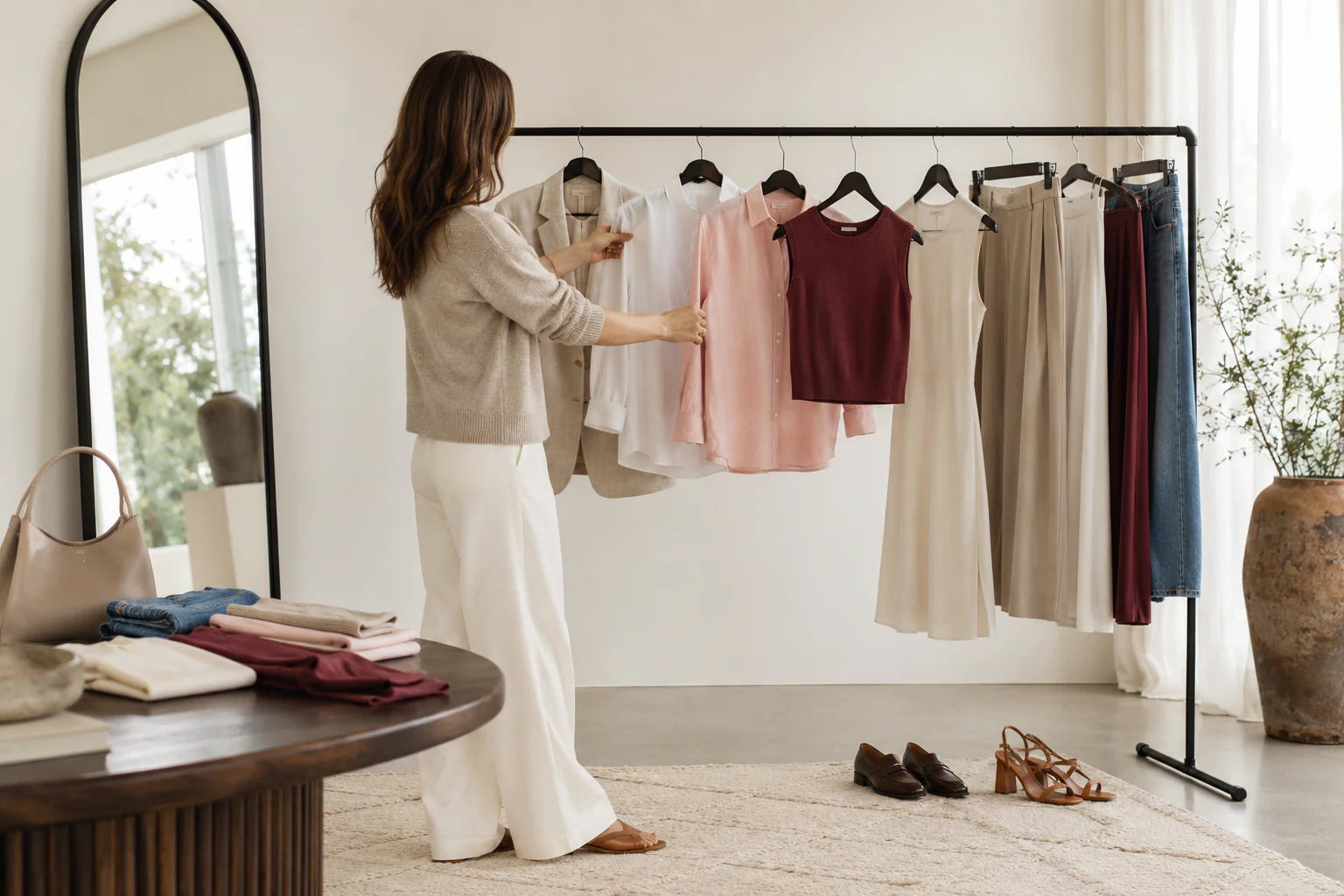
Start with your actual schedule and the clothes you already own. Use interchangeable basics to bridge commuting and weekend scenarios, factoring in summer temperature swings, comfort, and practical use.
What a Summer Capsule Wardrobe Is, and the Problem It Solves
A capsule wardrobe is a curated selection of pieces that can be mixed, matched, and worn repeatedly. The focus isn’t on hitting a specific item count, but rather on enabling a limited number of garments to be recombined to cover more real-life scenarios.
This approach is well-suited to solve the “closet full of clothes but nothing to wear” problem. Instead of continuously adding disconnected pieces, it’s more effective to first identify which clothes work together: can a single top pair with multiple bottoms, does a shoe work for different activities, and can an outer layer transition seamlessly between the office and casual settings?
A summer capsule wardrobe particularly needs to balance weekdays and weekends. The ultimate goal isn’t to create a universal checklist for everyone, but to reduce decision fatigue, making the items in your closet easier to see, style, and reuse.
Look at Your Schedule First, Not the Item Count
There is no universal standard for the number of items in a capsule wardrobe. Examples in existing resources vary significantly: some suggest starting with around 10 pieces, while another commercial guide uses 39 items to plan over 200 outfits. These numbers merely illustrate that the scale of a capsule can differ; they are not rules that must be followed.
A more practical starting point is to review your actual weekly schedule. List scenarios such as office meetings, working from home, daily commutes, running errands, dinners, and weekend leisure, then assess the frequency and dress code for each. Those who frequently attend office meetings might need more formal pieces, whereas those who primarily work from home might prioritize relaxed, comfortable, and out-and-out-ready combinations.
Your commute should also be factored in. Schedules that require a lot of walking elevate the importance of comfortable footwear, while frequent transitions into heavily air-conditioned indoor spaces necessitate reserving light layering pieces. Clarifying these needs before deciding on the size and formality of your wardrobe prevents an arbitrary number from overriding personal requirements.
Inventory Existing Clothes and Identify True Wardrobe Gaps
Building a capsule wardrobe doesn’t have to start with shopping. Resources suggest beginning with versatile basics you already own, only adding new items once genuine gaps have been identified. This not only reduces unnecessary spending but also prevents buying clothes that don’t fit your lifestyle just to complete a generic checklist.
When taking inventory, you can organize items into these three categories:
- Keep directly: Pieces that fit your current lifestyle scenarios and can be paired with multiple existing garments.
- Needs adjustment: Pieces that are appropriate in purpose but require re-evaluation regarding their pairing range, comfort, or scenario suitability.
- Genuine gap: Categories that cannot be replaced by your current wardrobe and will be worn repeatedly in your actual schedule.
When identifying gaps, don’t just ask “is it on the checklist?” but rather “without it, which actual scenario becomes impossible?” If existing clothes or alternatives can meet the need, there’s no need to make a redundant purchase. The final shopping list should only contain scenario-tested gaps, rather than a blind copy of an external template.
Build Core Item Categories Suitable for Summer
Recent summer editorial content lists candidate categories including neutral basic tops, skirts, dresses, straight-leg jeans, lightweight cardigans, comfortable low-heeled sandals or flats, and simple bags. These categories can serve as inventory prompts, but not everyone needs to own all of them.
When selecting, work backward from your personal scenarios:
- Basic tops: Prioritize evaluating whether they can be paired separately with your frequently worn trousers, skirts, or jeans.
- Skirts and dresses: Determine if they are needed based on office requirements and weekend activities, as well as the required level of formality.
- Straight-leg jeans: Only include them in your core rotation if your work environment permits them and you genuinely wear them often on weekends.
- Lightweight cardigans: Can serve as an add-on layer in air-conditioned environments and pair with multiple summer outfits.
- Sandals or flats: Comfort and walking needs should be weighted just as heavily as appearance.
- Simple bags: Choosing ones that transition well between work and leisure scenarios can reduce the need for frequent accessory changes.
The value of core categories lies in their interchangeability, not their quantity. If a certain item doesn’t align with workplace rules, personal style, body preferences, or daily activities, it can be removed or substituted with existing clothing.
Use Outfit Formulas to Connect Weekdays and Weekends
Weekdays and weekends don’t necessarily require two completely separate wardrobes. One transition example provided in the resources involves wearing tailored trousers, a blazer, and a T-shirt to the office; upon entering a more casual setting, you take off the blazer and change your shoes. The main pieces remain unchanged; only the more formal outer layer and accessories are adjusted.
You can establish a few simple formulas based on this concept:
- Trousers + T-shirt + Blazer + Dressier Shoes: For office scenarios requiring a certain level of formality.
- Same Trousers + Same T-shirt – Blazer + Casual Shoes: For running errands or more relaxed weekend plans.
- Skirt or Dress + Simple Shoes: Serve as a base combination; add a lightweight cardigan when entering heavily air-conditioned spaces.
The purpose of these formulas is to test whether pieces can transition, not to dictate fixed outfits. During your inventory, try changing just one variable: adding or removing a jacket, swapping shoes, or changing your bag. If a small tweak allows the same set of basics to adapt to the office, dinners, and leisure activities, they better align with the capsule wardrobe’s principle of repeated recombination.
Handle Outdoor Heat and Indoor Air Conditioning Simultaneously
Summer dressing requires confronting both outdoor heat and heavily air-conditioned indoor environments. Summer editors suggest using lightweight cardigans as an extra layering piece and opting for comfortable low-heeled sandals or flats. The resources also caution that uncomfortable summer footwear can cause blisters, making comfort a practical selection criterion when walking is required.
When planning, you can break each outfit down into a “base layer + optional outer layer.” The base layer handles outdoor activities, while the lightweight outer layer is deployed for the office or other air-conditioned spaces. This eliminates the need to prepare completely different outfits for different temperatures.
Weather, comfort, and intended function should also be evaluated jointly. The references here regarding fit, material, weather, and function are drawn from professional workwear resources; they are only suitable as general dimensions for choosing clothes and do not prove that a specific type of office fashion is the most appropriate. Specific trade-offs should still be guided by your personal work environment, commute method, and daily activities.
Check Fit, Material, and Use Before Buying
Once you have identified wardrobe gaps, you can evaluate candidate items across dimensions such as fit, size, material, weather adaptability, comfort, and intended use. These dimensions are derived from professional workwear resources and are suitable for general purchasing judgments, but they should not be interpreted as specific conclusions regarding American office fashion.
Before purchasing, you can verify item by item:
- Whether the fit and size align with your planned activities and how you intend to wear them;
- Whether the material is appropriate for the expected weather and usage scenarios;
- Whether the item will be comfortable during your commute, indoor work, or weekend activities;
- Whether it fulfills the uses already identified on your shopping list;
- Whether it can be paired with multiple existing garments, rather than only forming a single outfit.
Clothing labels can be used to check fiber composition. The regulatory example in the resources comes from the European Union: textile products sold to consumers are required to indicate their textile fiber composition. This can only serve as a basis for “checking the label to understand fiber composition” and cannot be stated as a U.S. legal requirement.
Outfit Testing and Refinement Checks Before Finalizing the Wardrobe
Before buying or finalizing your list, conduct an outfit test using your existing clothes. Check whether each candidate item can be paired with multiple garments, whether they can cover the actual work and weekend scenarios that arise in a week, and whether they exist solely to satisfy a generic checklist.
If two items serve the same function, you can prioritize keeping the one that better fits your schedule and is easier to style. If a candidate item lacks a clear use case, or if you already have an alternative, it should be removed from your shopping list. Conversely, if a high-frequency scenario consistently cannot be fulfilled by your existing wardrobe, only then should that corresponding category be retained as a true gap.
Finally, return to your weekly schedule and double-check item by item: do you have viable outfits for office meetings, working from home, commuting, running errands, dinners, and leisure activities? Completing this step before creating a shopping list strictly for confirmed gaps keeps the capsule wardrobe streamlined and closely aligned with real life.
Disclosures and Limitations
- This article was compiled and written with the assistance of AI. The content only synthesizes the provided Research Package and the approved Content Plan; no purchases, try-ons, interviews, or product testing were conducted.
- The facts and recommendations in this article are based on the materials corresponding to the listed sourceIds; commercial pages and editorial recommendations serve merely as capsule wardrobe examples and do not represent universal standards.
- This article did not receive product records, nor does it provide specific products, prices, inventory, ratings, or purchase links. It also contains no known affiliate marketing relationships; if product recommendations or affiliate links are added in the future, their commercial nature should be explicitly disclosed separately.
Sources
- Pracovní odevy » pracovní oblečení | Strauss — Strauss
- – YouTube — youtube.com
- Summer 2026 Capsule Wardrobe Guide | Everyday Style — Everyday Style
- Buy Home Products Online — IKEA
- News — canis.cz
- Textile Label – Your Europe — Your Europe
- Textile and Fabric Selection — linkedin.com
- I Curated a Summer Capsule Wardrobe—Here's What's in My Cart — Who What Wear
- Clothing Label Industry Statistics & Market Data (2026) | QWL — qualitywovenlabels.com
- Outfit ideas: how to create a capsule wardrobe — Heatworld