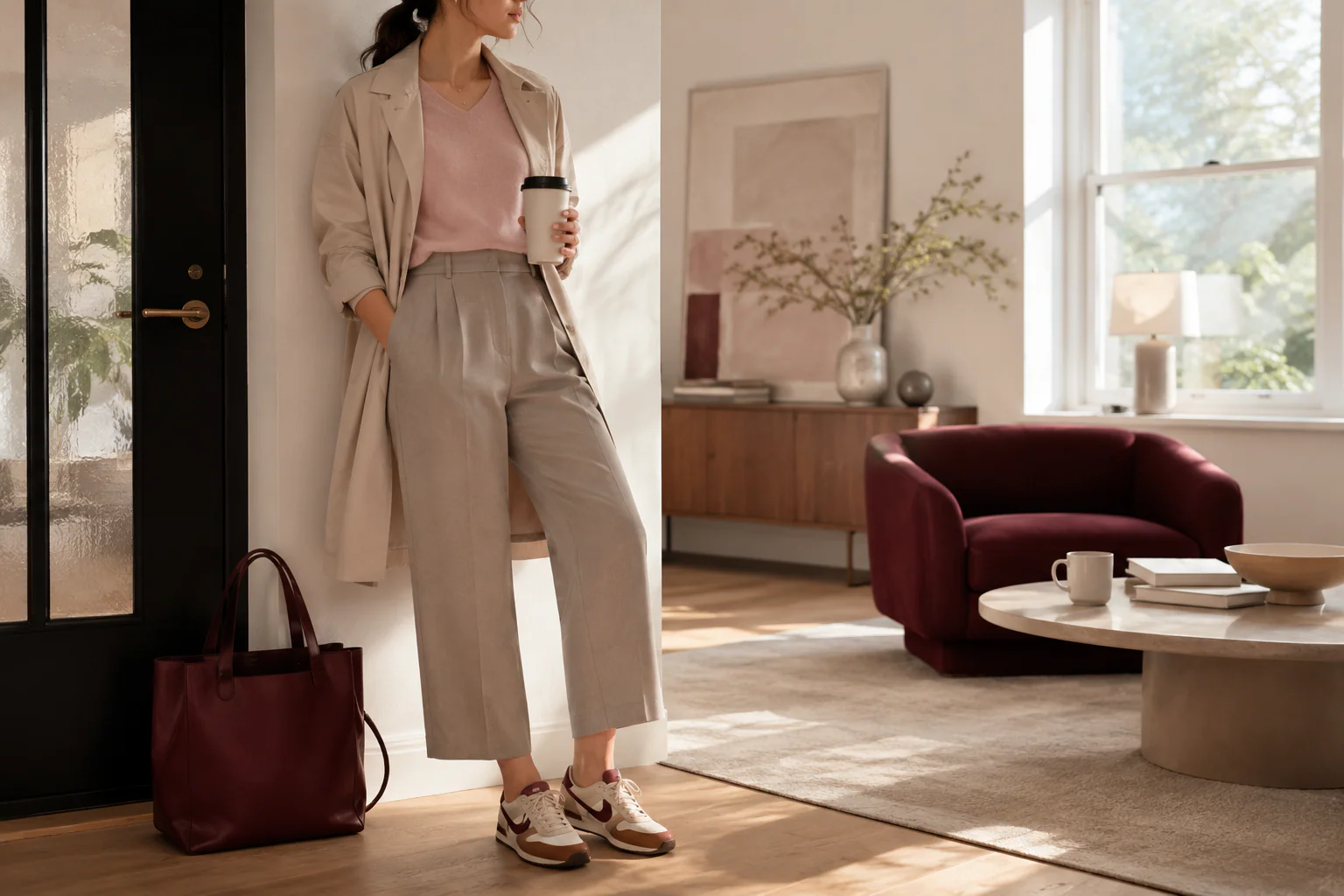
From the office to the weekend, this guide breaks down retro sneaker color palettes, pant and skirt proportions, support needs, and fit by occasion. The styling suggestions in this article are editorial concepts supported by sources, not real-time trend forecasts for 2026 or rigid rules that apply to everyone.
Assess the Occasion First: How Commute and Weekend Styling Differ
How to style retro sneakers depends primarily on the day's setting. Commute outfits usually require keeping the casualness in check: whether the upper is clean, whether the colorway is understated, and whether the shoes can harmonize with blouses, skirts, or dress pants all affect how polished the overall look appears. Weekday examples provided by Harper's BAZAAR include pairing retro sneakers with a white shirt and a leather skirt; their related roundup also notes that in environments with more relaxed dress codes, certain updated sneaker designs can be worn for commuting and in the office, eliminating the need to change shoes upon arrival. However, this does not mean all offices or all retro shoe models are appropriate; actual choices should still be guided by your specific workplace dress code.
On weekends, the demand for formality can be relaxed. Combinations from the sources include retro sneakers paired with denim jackets, cardigans, and corduroy pants, as well as knitwear, jeans, and skirts. These offer adaptable styling directions, rather than conclusions about real-time fashion trends in 2026.
You can start with a simple assessment: if you need to enter an office that day, prioritize cleanliness and dress code compliance; if the day is mainly for casual weekend activities, shift your focus to material layering, color variation, and actual walking needs.
Commute Outfits: How to Reduce Casualness and Stay Polished
The key to reducing casualness is making the sneakers a controlled part of the overall look. Reference materials suggest prioritizing clean, understated retro sneakers for work settings, balancing their casual nature with garments that have cleaner lines, such as white shirts and leather skirts.
Another reference path is a combination of a striped long-sleeve shirt, a suede jacket, dress pants, and Nike Cortez. What’s worth noting here isn't that a specific brand or item must appear together, but rather the approach of using dress pants to establish a sharp silhouette while letting the striped top and jacket handle the layering. If an office requires a more formal look, you can reduce bright colors and stark contrasts; if the code is more relaxed, you can retain more casual elements.
Before heading out, confirm three things: whether the shoe upper is clean, whether your pants or skirt can maintain a clear silhouette, and whether the overall look complies with your office's explicit or default dress code. The sources only support that *some* sneakers are acceptable in more relaxed work environments; it cannot be assumed that any retro sneaker is suitable for the office.
Weekend Outfits: Adjusting the Relaxed Vibe with Denim, Knits, and Skirts
Weekend outfits can start with familiar casual materials. Pairing denim jackets, cardigans, and corduroy pants with retro sneakers builds depth through different textures; white retro sneakers, indigo jeans, and a bright knit sweater offer another simple path: keeping the bottoms and shoes in easily coordinated base colors while placing the visual focus on the knitwear.
Skirts can also be incorporated into weekend combinations. The sources showcase a knit maxi skirt paired with a leather jacket and suede retro sneakers, and also mention that slim sneakers can be worn with day dresses and midi skirts. These examples show that retro sneakers aren't only for jeans, but skirt length, shoe shape, and the wearer's actual proportions need to be observed together. A single editorial example shouldn't be treated as a universal rule for all body types.
To quickly put together a look, first identify the focal point: when choosing denim or corduroy, let the material layers take center stage; when choosing a bright knit sweater, keep the shoes and jeans relatively quiet; when choosing a dress or midi skirt, focus on whether the transition between the hemline and the shoe looks natural.
Color Coordination: Neutrals, Brights, and Accessory Matching
Neutral-colored shoes are ideal for those looking to simplify their outfit coordination. The source combination of white retro sneakers with indigo jeans and a bright knit sweater demonstrates how shoes can recede into a foundational role, allowing the top to become the visual focal point. For commuting, clean and understated shoes are also easier to pair with blouses, leather skirts, or dress pants.
Colored shoes, on the other hand, can be integrated into an outfit through coordination. An example from Harper's BAZAAR features plum-colored sneakers paired with a pleated midi skirt, a rugby shirt, and a brown suede bag. Wirecutter noted that the slim Adidas shoe model they tested comes in a variety of colorways, ranging from neutral to striking color blocking. From this, we can extract an editorial method: first determine whether the shoe is the background or the focal point; if the shoe color is striking, look for harmony with your top or bag. If the shoe color is neutral, leave the primary color emphasis to knitwear or other clothing.
This is not a fixed color formula. The sources showcase the styling judgments of specific editors and testers; actual choices still need to align with your existing wardrobe and the occasion's requirements.
Proportion Adjustment: How to Pair with Wide-Leg Pants, Midi Skirts, and Maxi Skirts
According to the sources, slim sneakers can be paired with barrel jeans, wide-leg pants, midi skirts, and day dresses, and there is also an example of a knit maxi skirt paired with suede retro sneakers. These combinations provide a starting point for observing proportions: when loose pants or longer hemlines occupy a larger visual area, whether the shoe profile is slender, how much of the upper is visible, and how the pants or skirt connects with the shoe all affect the overall impression.
Wirecutter noted that the slim-profiled, very thin-soled Adidas Tokyo model they tested can visually elongate the leg line. However, this observation applies only to that specific tested model. It cannot be generalized as a common effect of all retro sneakers, nor should it be viewed as an objective conclusion applicable to all body types.
When styling, observe yourself from both the front and side in a mirror: Are the pant hems completely covering the shoe upper? Does the space between the skirt hem and the shoe opening look cramped? Does the looseness of the top and bottom make the shoes disappear? If the proportions aren't quite right, adjust the pant hems, skirt length, or top silhouette first before deciding whether to change the shoe model. These judgments are editorial recommendations compiled based on source examples.
Comfort Check: Thin Soles, Support, and Walking Needs
There can be a trade-off between a sharp appearance and the comfort required for extended walking. Wirecutter's review focuses on lightweight, slim sneakers suitable for the office or outings, evaluating them based on styling versatility, comfort during light activity, overall quality, and value. Their research covered over 50 shoe models, and they physically tested 13 of them.
The review points out that slim sneakers generally look sharper than bulky training shoes, but some ultra-thin soles offer limited support and may not be suitable for those who require more support. This conclusion cannot be expanded to mean that all retro sneakers lack support; rather, it serves as a helpful reminder for purchasing and pre-outing checks.
When assessing, first estimate the day's walking distance and standing time, then factor in your own support needs. If your itinerary mainly involves light activity in an office, the evaluation can focus on basic comfort and styling harmony; if extended walking is required, you shouldn't make a decision based solely on a slender profile or sharp appearance, but should rely on the support and walking performance experienced during an actual try-on.
Fit Check: Sizing, Shoe Length, and Heel Friction
Your usual shoe size is only a starting point and cannot replace trying on a specific model. Wirecutter found that the tested Adidas Tokyo ran long and suggested considering a half-size down; on another specific model, some testers experienced blisters from the relatively high and stiff heel counter of the Samba OG. These are results from specific shoe models and testers, and do not represent the same outcomes for other models within the same brand or for all retro sneakers.
When trying on shoes, check the following in sequence: whether the shoe length leaves appropriate space when standing; whether your foot slides back and forth inside the shoe during normal walking; whether the heel is stable; and whether a stiffer or higher heel counter causes continuous friction. You should also pay attention to whether the sole support meets your needs.
If the shoe length, heel structure, or support feels off, do not ignore the issue simply because it matches your usual size. The final size and fit should be determined based on actual standing and walking results.
Pre-Outing Checklist: Confirming Everything from Occasion to Full Outfit
First, confirm each item based on the day's setting:
- Occasion: Is today an office commute or weekend casual? Does the office allow sneakers?
- Cleanliness: Is the shoe upper clean and understated enough for a commute outfit?
- Item Coordination: Can blouses, skirts, or dress pants balance the casual feel of the shoes? Does the weekend outfit need denim, knits, or corduroy to add layers?
- Color: Will the shoes act as a base color or a visual focal point? Do colored shoes coordinate with your top or bag?
- Proportions: Is the transition between the pant hem or skirt hem and the shoe upper natural? Are wide-leg pants, midi skirts, or maxi skirts completely overwhelming the shoe profile?
- Itinerary: Will the estimated walking and standing time exceed the scope of light activity?
- Support: Does the thin-soled or slim appearance meet your actual support needs?
- Fit: Is the shoe length appropriate when standing and walking, is the heel stable, and is there any continuous friction?
These items organize commute, weekend, proportion, and try-on information from the sources into a decision-making checklist; they do not imply that all shoe models require the exact same answers. Apply the checklist first, then decide on your footwear and outfit based on office dress codes, walking duration, and actual try-on results.
Disclosures and Limitations
- This article was compiled and organized with the assistance of AI, and the factual basis is drawn solely from the provided Harper's BAZAAR editorial materials and Wirecutter review materials; styling suggestions have made every effort to distinguish between source facts, specific shoe test conclusions, and editorial generalizations.
- This article does not claim that the author or AI has personally purchased, tried on, or used any products. The sizing, support, and heel friction information mentioned herein applies only to the test subjects explicitly cited in the sources and cannot represent all retro sneakers.
- This article does not constitute real-time trend, pricing, or inventory information. No structured product data, prices, ratings, or review counts were provided in the input, and thus no product rankings or purchase recommendations have been generated.
- This article does not contain affiliate links. If product links are added in the future, any potential affiliate commission relationships should be prominently disclosed, and pricing, inventory, and shopping guide attributes should be independently verified.
Sources
- 23 Retro Sneakers That Make Any Outfit Cooler — Harper's BAZAAR
- Women's Fashion Sneakers – Free Shipping On Items Shipped From… — temu.com
- Robot or human? — walmart.com
- Styling tips for women with wide hips | C&A — c-and-a.com
- Designer Sneakers: Chic Parisian Casual Style | Anne Fontaine — annefontaine.com
- Our Favorite Slim, Stylish Sneakers — Wirecutter: Reviews for the Real World
- High-Quality Shoes for Men | Manufactum — manufactum
- Casual Sneakers for Men — Neeman's
- History of fashion design – Wikipedia — en.wikipedia.org
- 8 Fall Outfits That Prove How Cool Retro Sneakers Can Be — Harper's BAZAAR