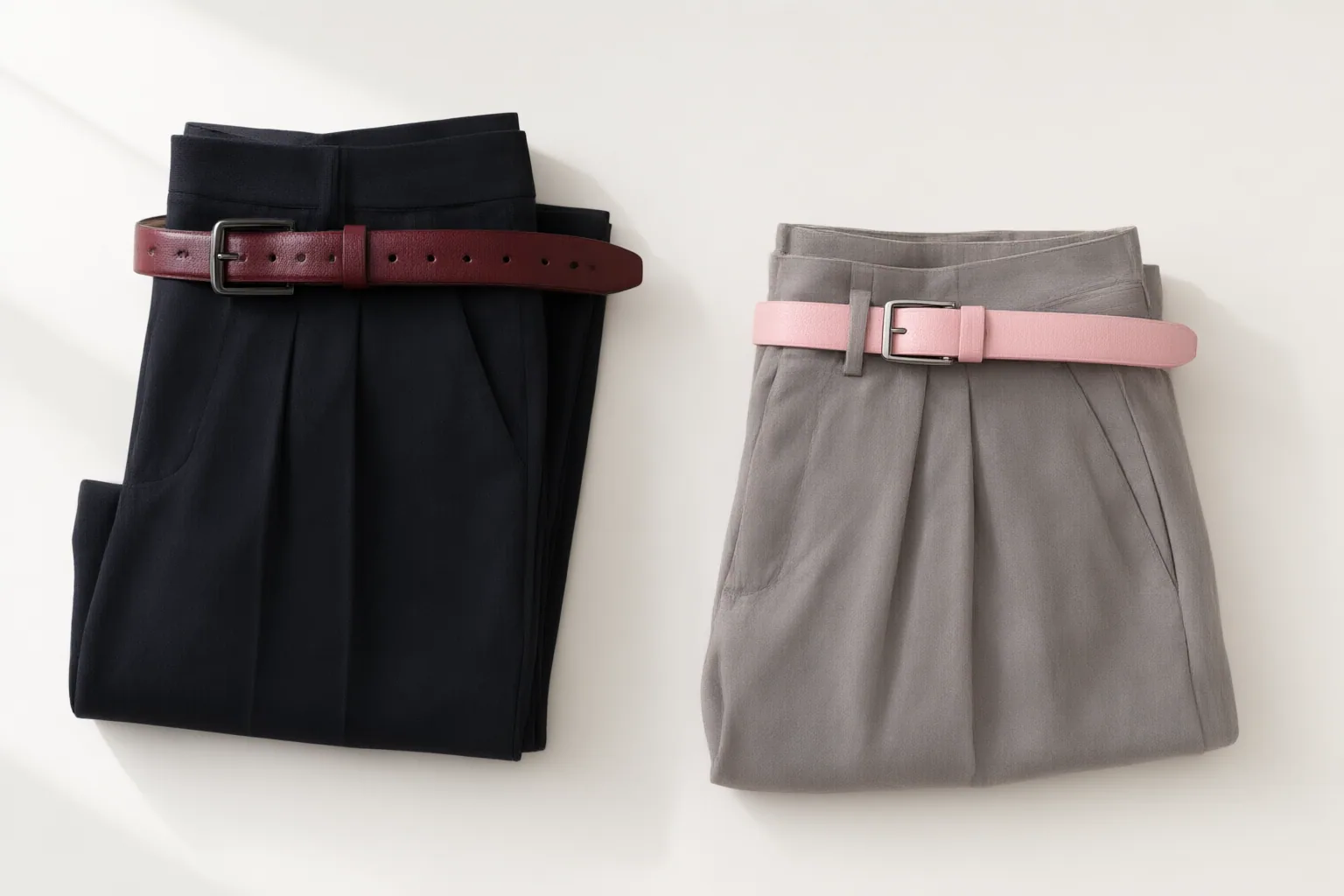
A conventional prong belt may offer only one-inch steps between settings, so one hole can feel tight while the next feels loose. An adjustable buckle-end construction changes the belt’s overall length differently. For low-, mid-, or high-rise trousers, evaluate the belt with the exact garment rather than relying on an unsupported universal size conversion.
Why Conventional Belt Holes Can Create a Fit Compromise
Conventional dress belts commonly fasten when the buckle engages one hole in a series near the belt’s free end. According to the cited adjustable-belt patent, those holes are commonly spaced one inch apart. That interval limits the available fit choices: if one position feels too tight, moving to the adjacent hole may make the belt feel too loose.
This explains why a labeled belt size alone cannot describe every possible setting. The relevant issue is not simply whether the belt closes, but whether one of its fixed positions provides an acceptable fit with the intended trousers. The source establishes the typical hole mechanism and spacing, but it does not provide a sizing formula for different trouser rises or rules governing belt-tail length.
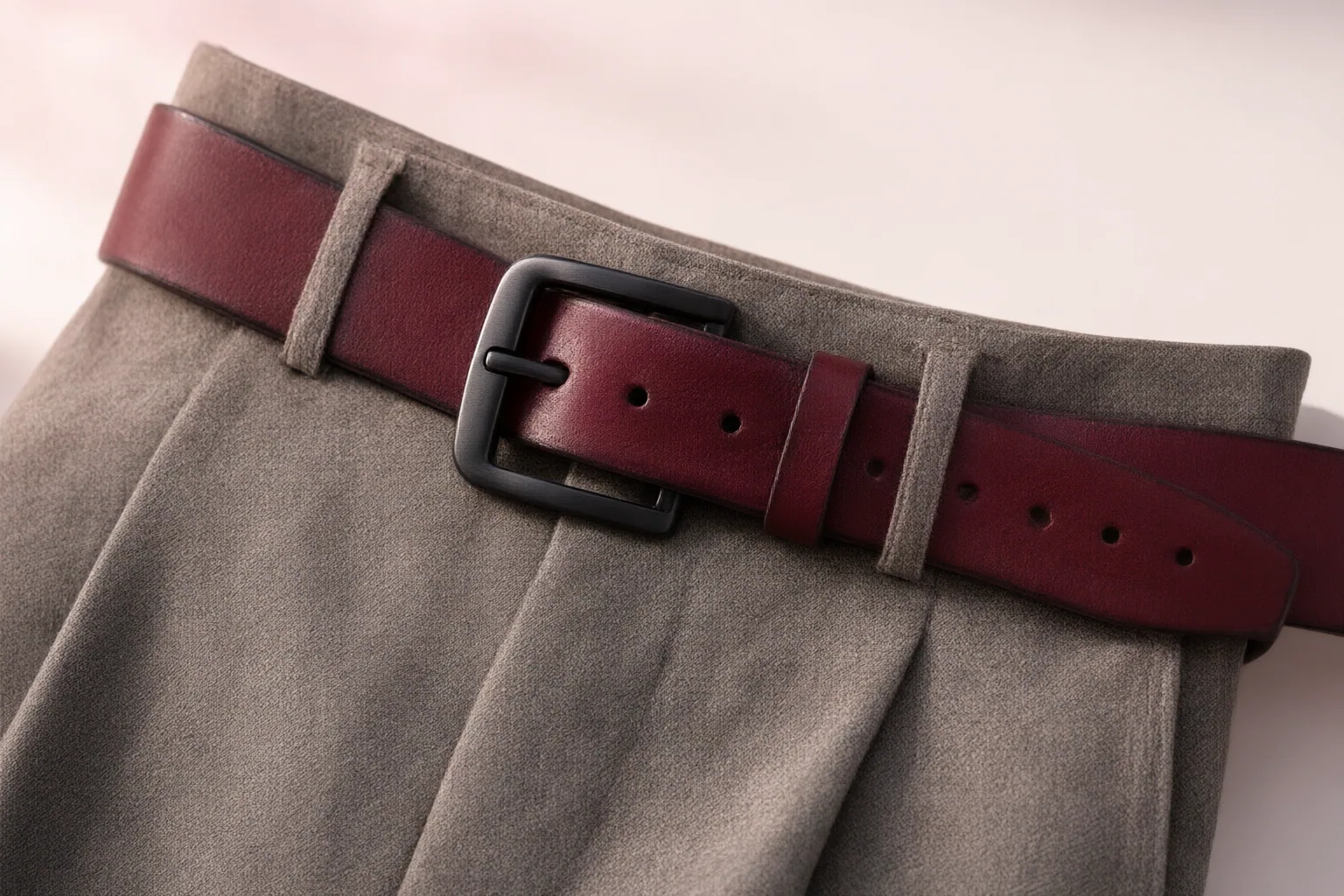
What an Adjustable Buckle-End Design Changes
The cited patent describes another approach: changing the belt’s overall length at the buckle end. Its construction varies the length of an overlapping folded portion, also described in terms of the buckle loop. This is distinct from choosing only among the holes at the free end.
That distinction matters when comparing adjustment systems. A fixed-hole belt offers discrete positions determined by its hole placement, while the described construction adds a way to alter overall length near the buckle. The source does not establish that this mechanism is more comfortable, prevents gaps, produces an ideal tail, or outperforms every conventional belt. It supports only the narrower conclusion that buckle-end adjustment changes how overall belt length can be set.
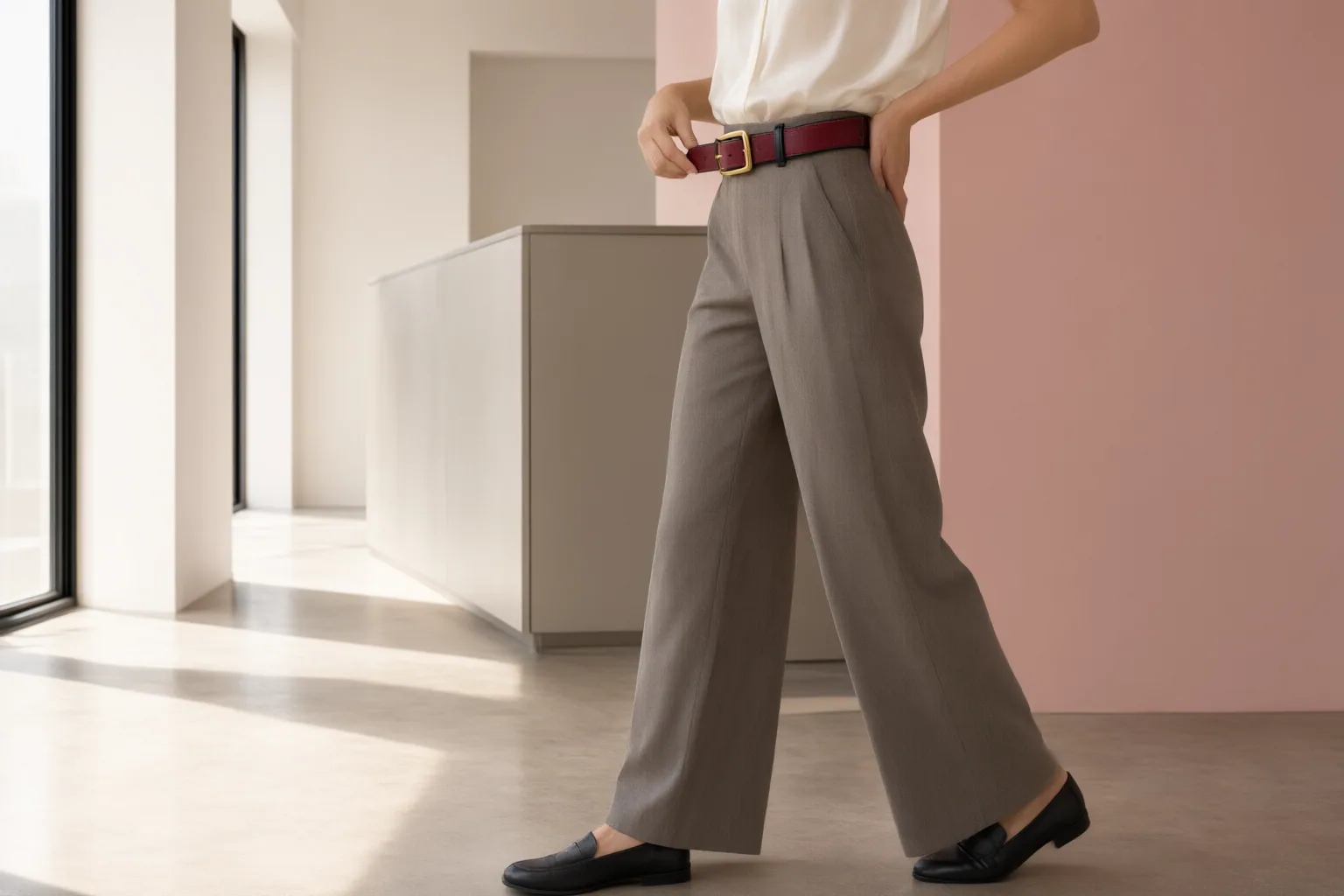
How to Evaluate Fit With Different Trouser Rises
A cautious evaluation starts with the specific low-, mid-, or high-rise trousers you plan to wear. Put the belt through that garment’s loops and compare the two neighboring usable holes. Note whether one setting feels tight and the next loose—the compromise that can arise from one-inch spacing. If neither position is acceptable, an adjustable construction may be relevant because the cited design permits overall-length changes at the buckle end.
Treat this as a garment-specific comparison, not a universal conversion rule. The supplied evidence does not establish where to measure the body or garment for each rise. It also does not define an ideal amount of visible tail or prove that a particular size will prevent waist gaps or belt-loop distortion. One other supplied page lists 1-by-42-inch abrasive sanding belts; those industrial dimensions have no supported application to wearable belt sizing. Do not use them as a fashion size reference.
Conclusion
The supported difference is straightforward: conventional prong belts commonly rely on holes spaced one inch apart, whereas the cited adjustable design changes overall length by varying a folded portion or buckle loop at the buckle end. Neither source supplies reliable size conversions for low-, mid-, and high-rise trousers, and abrasive sanding-belt dimensions are unrelated to wearable sizing.
Check your belt on two neighboring holes while wearing the trousers you intend to pair with it. Then decide whether one fixed setting is acceptable or whether a construction offering buckle-end length adjustment better matches the fit range you need.
Disclosures and limitations
- This article was prepared with AI assistance using only the supplied patent description and abrasive-product category page; claims are limited to what those sources support.
- No products are recommended and no affiliate relationship is represented. Any future shopping links should be checked for affiliate status, current availability, and fit information.
Related reading
Sources
- US10244825B2 – Adjustable belt – Google Patents — patents.google.com
- 1 X 42 Inch Sanding Belts — Red Label Abrasives