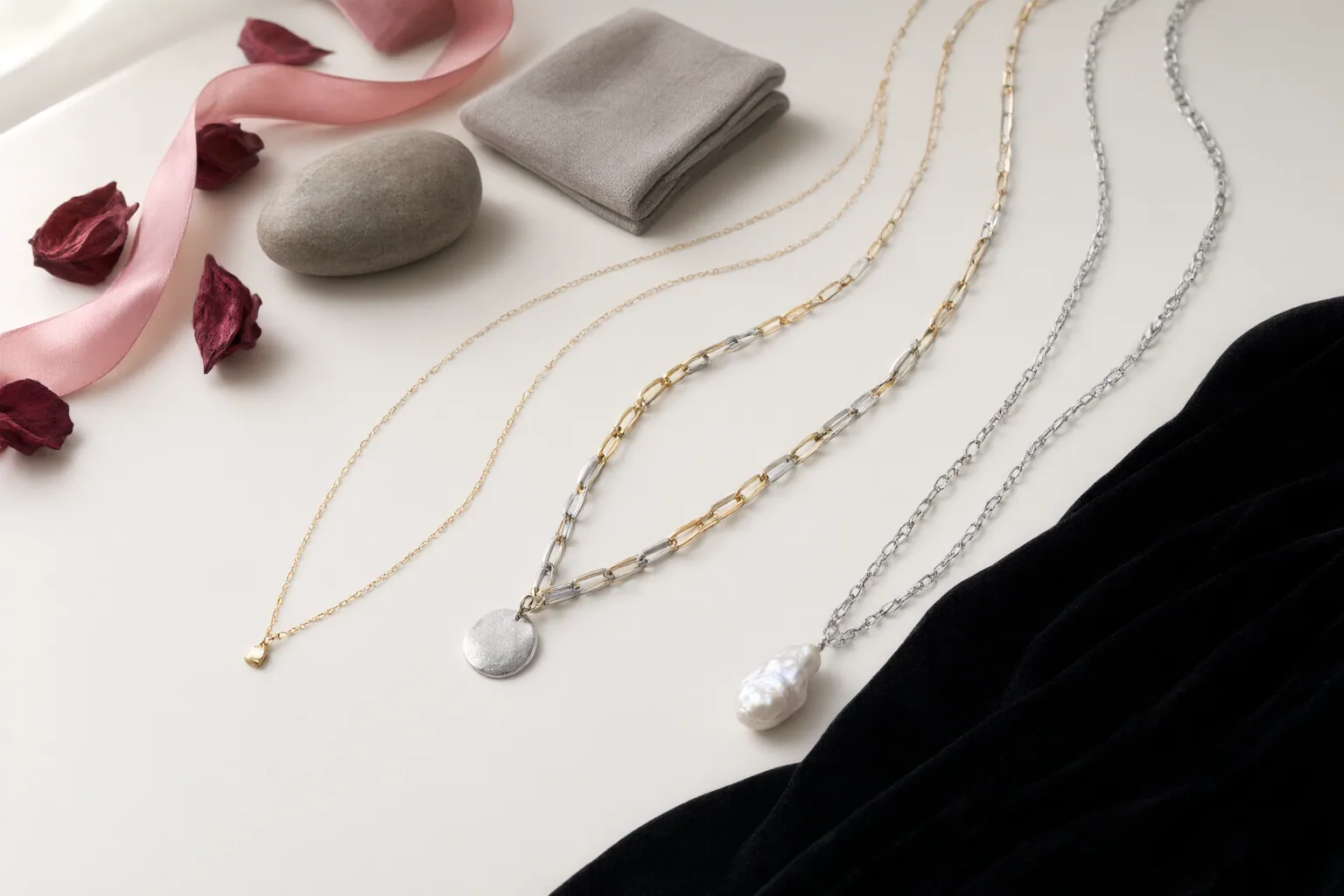
Everyday jewelry styling becomes simpler when you assess the occasion and outfit detail first, choose one visual focus, balance the scale of each piece, and match maintenance to both material and wear frequency. The available research does not support fixed necklace formulas for specific necklines.
Build an Everyday Jewelry Styling Framework
Begin with three questions: Where are you going, how visually detailed is the outfit, and where should attention land? One jewelry styling guide recommends simpler pieces for casual and workplace settings. It also suggests pairing patterned or detail-heavy clothing with restrained jewelry, while allowing a plain outfit to carry a more prominent necklace or earrings.
Treat these as practical styling judgments, not universal rules. Their value lies in reducing competing focal points. If the clothing already supplies color, pattern, texture, or ornament, jewelry can play a supporting role. If the clothing is visually quiet, one stronger piece can provide definition. This sequence creates a repeatable starting point without requiring every item to match.
Coordinate Metal Tone, Scale, and Layering
Mixed metals do not have to be treated as a mistake. The cited styling guide says layering need not be restricted to one metal tone and proposes using a repeated color theme to connect different pieces. In practice, repetition can make the combination appear intentional: rather than demanding exact uniformity, look for a tone that appears more than once across the selection.
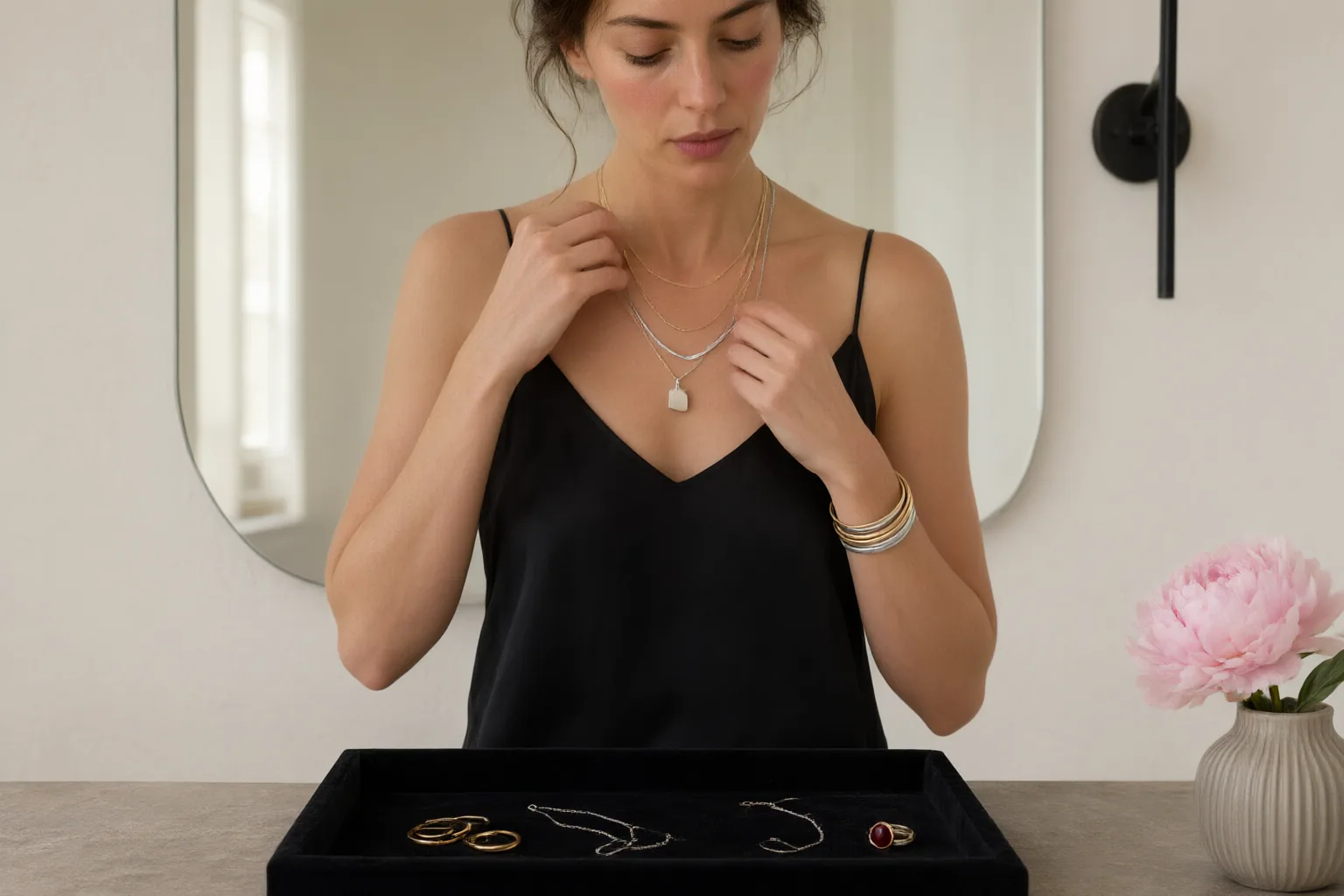
Next, check proportion. For layered necklaces, the guide recommends varying chain lengths so that the pieces form distinct levels instead of occupying the same visual space. It also suggests balancing a substantial necklace with smaller jewelry, such as studs. This does not prohibit wearing several bold pieces; it offers a way to control how many elements compete for attention.
A useful edit is to identify the intended focal piece, then reduce or resize anything that distracts from it. Review the combination as a whole rather than judging each item separately.
Factor Necklines, Wear Frequency, and Material Care into the Decision
Neckline is a reasonable part of a styling decision, but the supplied research does not establish rules pairing particular necklace shapes or lengths with specific necklines. Avoid turning unsupported formulas into requirements. Instead, use the supported checks—outfit complexity, focal point, necklace-length variation, and scale—and assess the complete silhouette visually.
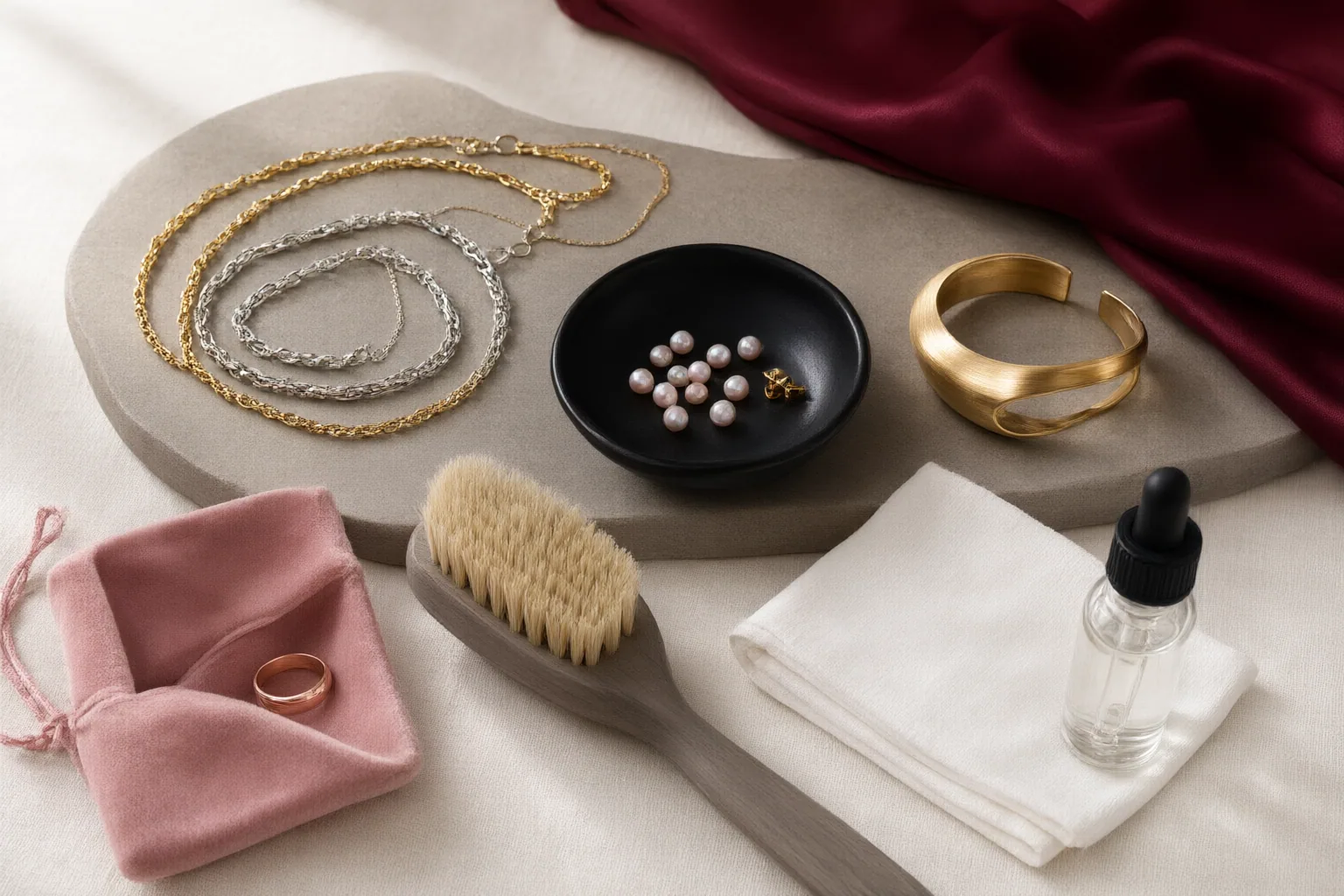
Wear frequency adds a more concrete constraint. Frequently worn jewelry encounters oils, lotions, household cleaners, friction, and storage conditions that may contribute to dullness or loss of shine. Wirecutter, citing jewelry-care professionals, reports that most jewelry can be cleaned with dish soap and warm water. Material exceptions matter, however: gold-plated and vermeil pieces should receive less rubbing because friction can wear the plating.
Pearls require a different routine because they are porous and easily damaged. The source recommends wiping them only with a slightly damp microfiber cloth, without soaking them or applying chemical cleaners. Storage also deserves attention: keep jewelry out of direct sunlight, since prolonged ultraviolet exposure may fade some gemstones. Before cleaning, identify the material rather than applying one method to every piece.
Conclusion
Use a short final check: assess the occasion and clothing detail; choose one focal point; balance substantial and delicate pieces; separate layered necklaces by length; and connect mixed metals through a repeated color theme. Then consider how often each piece is worn and select care appropriate to its material.
Choose one frequently worn outfit today. Compare a restrained jewelry combination with one more prominent option, note which creates the clearer focus, and record every jewelry material before deciding how to clean or store it.
Frequently asked questions
Do mixed-metal jewelry combinations need to match exactly?
No. The cited styling guide says layering can include more than one metal tone. It recommends coordinating the combination through a recurring color theme, which offers a visual connection without requiring every piece to use the same metal.
Can pearls and plated jewelry be cleaned like most other jewelry?
Not in every respect. Although dish soap and warm water are described as suitable for most jewelry, plated and vermeil pieces should be rubbed less. Pearls should only be wiped with a slightly damp microfiber cloth and should not be soaked or exposed to chemical cleaners.
Disclosures and limitations
- This article was prepared with AI assistance using only the supplied styling and jewelry-care sources. Styling guidance is source-attributed editorial advice, not universal professional consensus; no product, price, inventory, testing, or affiliate claim is included.
Related reading
Sources
- Jewelry Styling Secrets: Ultimate Guide to Wearing Jewelry — grsilverdesigns.com
- How to Clean and Care for Your Jewelry — Wirecutter: Reviews for the Real World