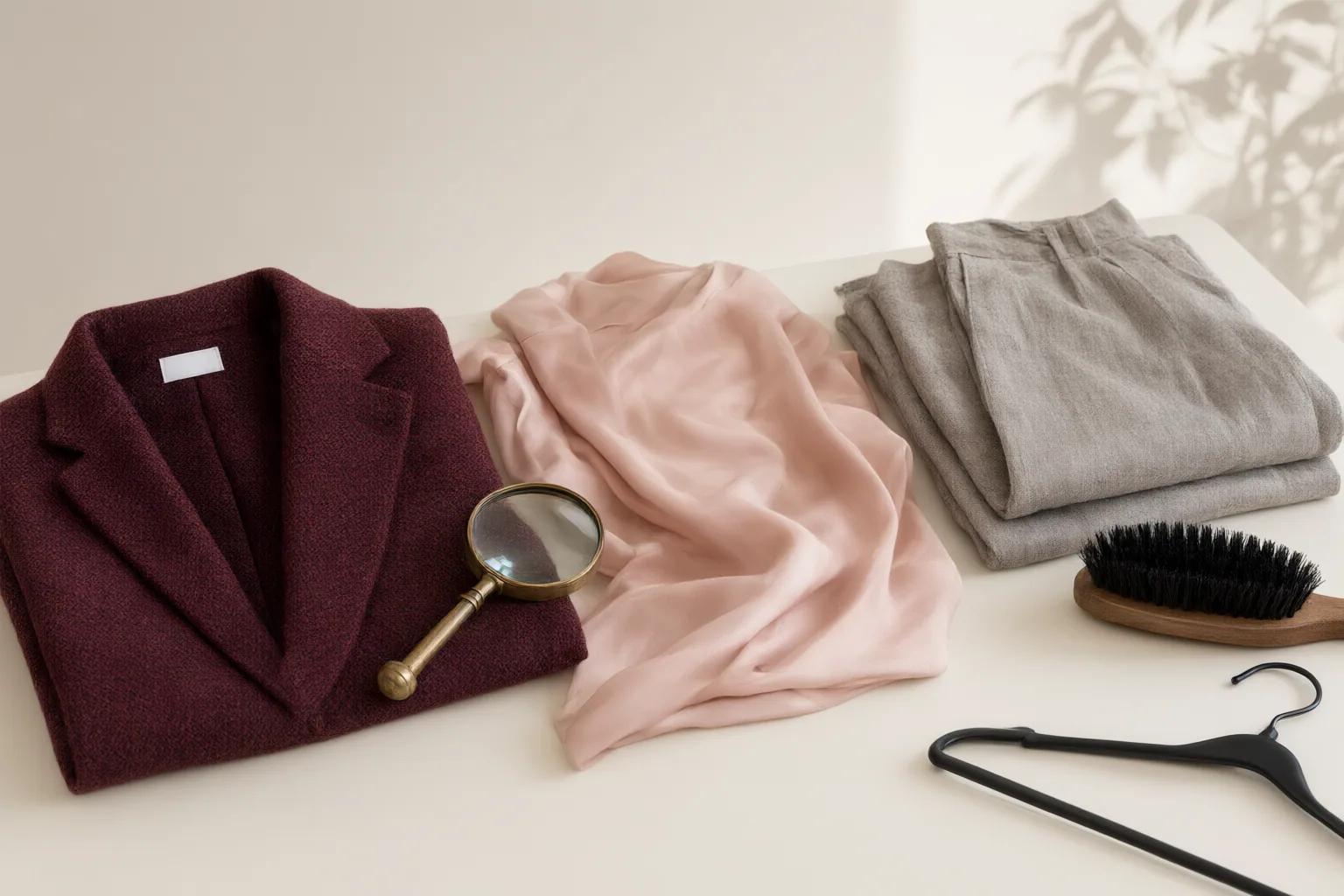
Before buying a garment, read the complete label—not just the size. Fiber percentages and care instructions can reveal what the item contains, how it must be cleaned, and whether professional care or restrictive temperature limits could add cost or inconvenience.
Start With the Fiber Content
Begin with the names of the fibers and their proportions. This gives you a concrete basis for comparing garments instead of relying on general fabric descriptions.
Under the cited EU framework, fibers are listed in decreasing percentage order, and composition information must be clearly separated from details such as care instructions. That means the largest component appears first. In the same jurisdiction, terms such as “100%,” “pure,” or “all” may be used only when the textile consists exclusively of one fiber type.
Use these principles as a practical reading method, but not as a statement of US law: the cited rules apply to textiles marketed in the EU. For a US purchase, focus on what the displayed fiber names and percentages actually disclose, and compare the complete blend across options.
Decode the Five Areas of Care Instructions
Read the care label category by category. The Australian guidance cited here organizes care symbols into five areas: washing, bleaching, drying, ironing, and professional care. Checking only the wash symbol can leave important restrictions undiscovered.
Temperature numbers are limits, not suggestions to exceed. Examples in the guide include maximum wash temperatures and hand washing at up to 40°C. Drying instructions distinguish low-temperature tumble drying at up to 60°C from normal tumble drying at up to 80°C. Ironing symbols may specify maximum plate temperatures of 110°C, 150°C, or 200°C.
Also check whether bleaching is permitted and whether professional treatment is required. Taken together, the five categories describe the cleaning process more completely and can help prevent avoidable damage. These examples come from Australian care guidance; they should not be interpreted as US legal requirements.
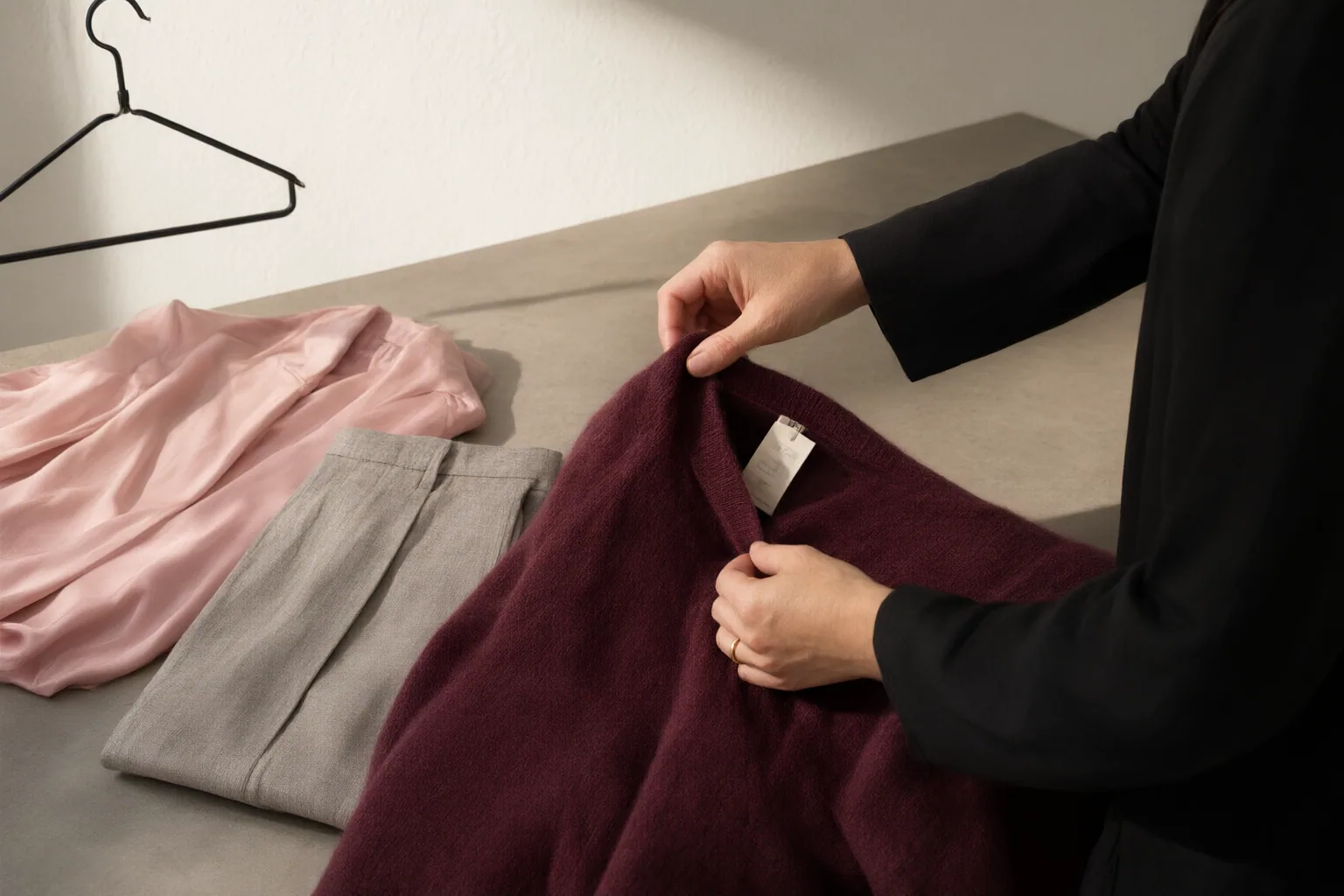
Spot Hidden Upkeep Before You Pay
Translate every instruction into a task, cost, or constraint before deciding to buy.
- Check whether the garment requires dry cleaning or another professional service.
- Compare its wash-temperature limit with your normal laundry routine.
- Confirm whether your usual drying method is allowed and whether a lower tumble-dry temperature is required.
- Review bleaching and ironing restrictions, including any maximum ironing temperature.
- Decide whether you can reliably follow the entire process over repeated wear.
Professional-care requirements may add expense after checkout. Instructions that conflict with your routine can also create inconvenience, while misreading washing, bleaching, drying, or ironing directions may contribute to dye transfer or irreversible damage. Fiber percentages and care needs therefore work best as a combined decision check: first establish what the garment contains, then assess what maintaining it demands.
The composition framework cited here is EU-specific, while the care guidance concerns Australia. Use both as label-reading aids rather than claims about US regulation.
Conclusion
A useful label check takes less time than dealing with an unsuitable care routine later. Read the fiber names and proportions, then review washing, bleaching, drying, ironing, and professional-care instructions without skipping a category. Pay particular attention to dry-cleaning needs and maximum temperatures.
Before buying your next garment, read or photograph the full label and confirm that its fiber blend and complete care routine fit your habits and budget.
Disclosures and limitations
- This article was prepared with AI assistance using only the supplied Your Europe and ACCC Product Safety research. The cited requirements are jurisdiction-specific and should not be treated as statements of US law.
Related reading
Sources
- Robot or human? — walmart.com
- Care labelling on clothing and textiles guide — ACCC Product Safety
- Zippers – Taking It Up a Notch — Taking It Up a Notch
- Client Challenge — scribd.com
- Tailored Jacket Construction Method – The Tailoress — The Tailoress
- Textile Label – Your Europe — Your Europe
- Zippers – Alison Wheeler – The Sewing Lady — Alison Wheeler – The Sewing Lady